Drain Smells like Sewage - How to Stop Sewer Vent Smell
What causes sewage and Drain smells? (This page is for information only)
There is nothing worse than a smell in your kitchen or bathroom that you simply cannot trace or eliminate. All the disinfectant in the world poured down the sink only relieves the smell temporarily - a sewage smell that seems to stink of the drains.
Causes of Smelly Bathrooms and Kitchens
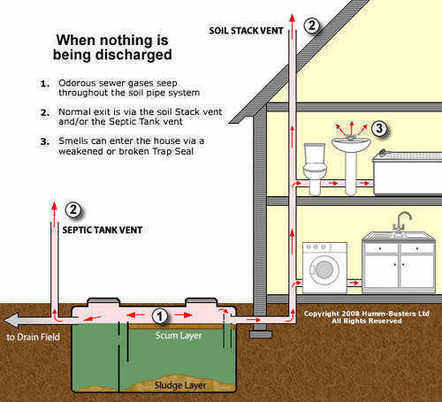
- The number ONE cause of sewage smells in the house is the lack of a soil vent pipe to vent the drains. These SVP's are also known as 'Stench Pipes' for a very good reason - they prevent the stench from going into the house and vent it out of the top of the SVP instead. Many plumbers use Air Admittance Valves (Durgo valves) instead of an SVP. These are fine for houses connected to mains drainage, but NOT for ones with a septic tank or sewage plant - unless you want a smelly house.
- The new bath or shower has a continental 'easy-plumb' waste fitted. These are very common in new bathroom fittings and are becoming almost standard for showers, as they enable a low profile shallow shower tray to be fitted. The problem is that they do not have a trap at all and sewer gases come back up the pipes if the tray plug is not screwed back in place after the shower is used. Buy a 'HepVo Waterless Trap' to solve it.
The septic tank drains have 'backed-up' to the soil vent pipe inlet (if fitted outside the house, as is normal in older houses), blocking it. This is almost always caused by a failed soakaway and requires immediate remedial work.
A Jackdaw or other bird has built a nest in the soil vent pipe, preventing the smell from escaping.
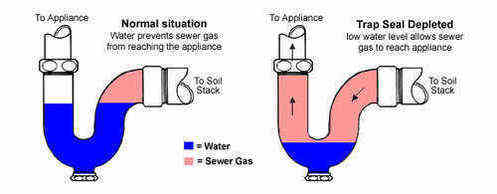
- If the sink or bath has not been used for a while, the water in the traps may have evaporated, allowing drain gases to leak back through the plug holes. If this is a regular problem, ring us for the solution.
Images courtesy of Humm-Busters Ltd.
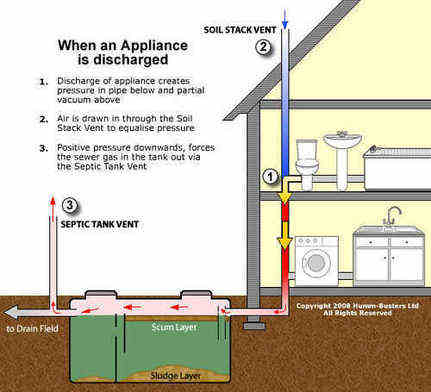
- The soil vent pipe is too small or has a cowl fitted that is too restrictive to air flow, causing a 'syphon' effect when water is flushed down the drains and creating a semi vacuum in the pipe. This pulls water out of the trap, causing an imperfect seal and allowing the smell to leak back through the plug hole.
Images courtesy of Humm-Busters Ltd.
-
The soil vent pipe is too close to a window opening, particularly Velux roof windows. This means that in certain wind conditions smells will blow in through the open window. You can either fit a Maxi-Vent together with the Aluminium Cover to the external pipe or, if you have loft access, cut a section out of the Soil Vent Stack and fit a Maxi-Vent to the top of the lower section.
Soil vent pipes which are not covered by a cowl or vent cap. When the wind blows from a direction that is on the opposite side of your house to your SVP, then air can be forced down the SVP as it drops over the roof. Trees and other buildings in the vicinity can have the same effect when the wind is in a certain direction. The gases that should be released by the SVP then are forced back into the drain system - and into your house, increasing your problems. The Maxi-Filtra and Maxi-Vent will stop all problems caused by wind speeds and direction.
But it stinks outside!
Smells outside usually emit from manholes, SVP's and septic tanks.
- No separate septic tank vent. If your septic tank is more than 10 metres from the SVP, then the SVP cannot vent it, as it is too far away. In these cases, the Septic Tank requires its own vent pipe on the outlet side of the tank, which must be situated within 10 metres of it and a minimum of 1.4 metres high. This should be fitted with a Maxi-Vent to prevent odours escaping from the vent pipe.
- Quite often, particularly on Barn Conversion sites which are designed around a courtyard, the gases from the SVP's drop and become 'trapped' in the yard due to the still conditions there. Trees, other buildings and the general topography of the area can also interfere with the efficiency of the SVP. The lack of 'draw' on the SVP also causes gases to escape from manhole covers and septic tank lids. To address the problem, fit a Maxi-vent to the outlet of the SVP.
- The septic tank vent pipe can also cause smells if it is too low or downwind. To get rid of the smell fit the Maxi-Filtra. This will allow two-way ventilation but will block the sulphides that cause the stink.