Septic Tank vs Sewage Treatment Plant - Which Do You Need?
The building regulations in the UK state that houses and other properties must be connected to a mains sewer wherever possible, so that wastewater and sewage can be disposed correctly and safely. If this is not possible, the property owner will need to look into other waste water solutions.
It is recommended that before committing to any solution, that you get in contact with qualified experts to make sure that you are purchasing a solution that works best for your property.
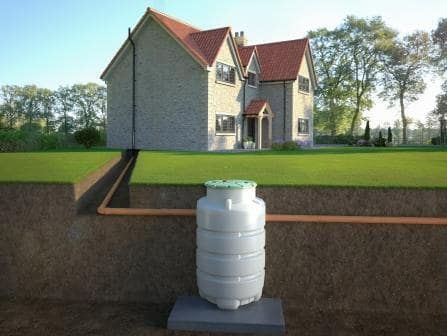
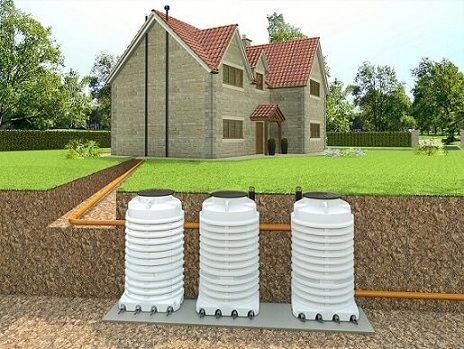
Two of the most common off-mains wastewater solutions that are available are septic tanks and sewage treatment plants.
When Do I Need an Off-Mains Wastewater Solution?
If your single property is within 30 metres of a possible public sewer connection, then you must connect to it and usually (but not always) cannot have either a septic tank or sewage treatment plant. This is the case even if the levels do not match up, as you must then use a pumping station to lift the wastewater into the mains sewer.
If you are discharging from more than one property, multiply the number of houses by 30 metres.
Example: If there are 3 properties, then this will give you a distance of 90 metres to the mains sewer (3 × 30 metres).
Septic Tank or Sewage Treatment System - What’s The Difference?
Many people often are confused about the differences between Septic Tanks and Sewage Treatment Plants, with some people even mistaking them as the same thing. There is actually a large difference between septic tanks and sewage treatment plants and how they are used in managing household wastewater.
Septic Tanks do not clean sewage, they make it worse by turning it septic. Septic tanks can only discharge the septic effluent into a drainage field (NOT soakaway), as the effluent is extremely polluting.
Sewage treatment plants clean the sewage. They have the option of discharging either to a drainage field or to a ditch, stream, river or other watercourse because the effluent is treated to a much higher quality.
Septic Tanks
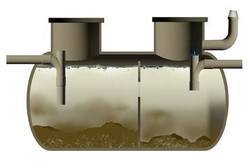
Septic Tanks were the old traditional method of managing sewage where no mains connection was possible. Septic Tanks do not treat sewage, they just separate water, solids and fats. They are an underground tank with 1, 2 or 3 chambers. They separate liquids from solids and fats. In each chamber, fats float to the surface and heavy solids sink to the bottom. The middle liquid layer then flows into the next chamber (for further separation) or out of the tank.
Nearly all modern Septic Tanks (such as EPIC) have only a single chamber with a filter in the outlet.
Because of a lack of oxygen, Septic Tanks turn the water and sludge septic.
Septic Tanks are only part of a Septic System.
A septic system consists of a Septic Tank and a Drainage Field. Never think of a Septic Tank on its own.
In a septic system, all the Septic Tank does is separate the liquid waste from the solids and fats.
The Drainage Field is a network of pipes, bedded on stone and laid in the top metre of soil (no deeper). It has two jobs:
Primary Job = to aerobically treat the water.
Secondary Job = to dispose of the effluent.
The septic effluent from the Septic Tank flows into the Drainage Field. The Drainage Field pipework spreads the effluent over a large area and allows the effluent to trickle out and into the gravel below. The gravel creates a large surface area and because it is within 1m of ground level, aerobic bacteria colonise the gravel and give basic treatment to the effluent before it is soaked into the soil.
Septic systems are a primitive method to treat sewage and whilst they do limit the pollution caused, they are not comparable to a Sewage Treatment Plant. Drainage Field regulations/requirements have made Septic Tanks unviable for most areas in the UK as the majority of sites cannot have a Drainage Field. No Drainage Field = No Septic Tank.
For a site to be suitable for a Drainage Field, it must meet the following criteria:
2m of free draining soil - no water, clay, bedrock, etc.
A very large area of pedestrian grass (lawn or paddock - no vehicle traffic). Single domestic houses typically need 100-250m2.
No trees within 20m.
For more information on Drainage Fields, please click on this link.
Septic Tank Factors to Consider
Only separates solid and liquid waste, but does not treat it.
70% of sites will fail the regulations that allow septic tanks to be installed.
The liquid waste is very polluting to the soil and will kill any earthworms it touches.
Requires regular emptying - at least once a year.
Is not allowed to discharge into any watercourse, even by accident.
More expensive to install than a sewage treatment plant which discharges to a watercourse.
Most modern properties also don't own enough land to enable a soakaway drainage field to be installed. You need a VERY large lawn area for a soakaway drainage field.
Mandatory Assessment
If you are considering using a septic tank instead of a sewage treatment plant, make sure that the ground is suitable for a foul water soakaway drainage field, as over 70% of UK sites fail the mandatory tests that allow them to be installed or replaced. Either the Soakaway Trial Site Assessment Hole, (to find out the highest level of the water table), or the Percolation Tests, (to find out how porous the soil is), fail these tests.
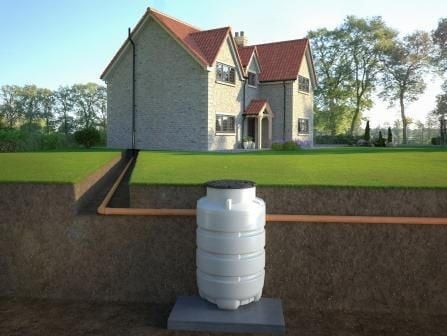
Sewage Treatment Plants
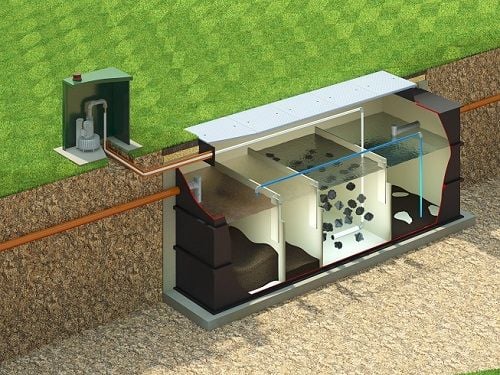
Sewage treatment plants are the modern method of treating sewage where no mains connection is possible. Domestic sewage treatment plants contain 1, 2 or 3 chambers, which separate solids from liquids, digest the pollutants and make the resulting effluent clean enough to be discharged either into a watercourse (stream, river or ditch) or a Drainage Field.
There are various designs, but they all achieve the same thing - clean effluent, resulting in the final discharge being significantly less harmful to the environment.
Sewage treatment plants - Factors To Consider
They digest the pollutants in the liquid part of the sewage and some also digest up to 98% of the solids as well.
They can discharge directly to watercourses.
The liquid waste is not polluting to the soil and will not kill any earthworms it touches.
Requires emptying on a regular basis - depending on the make, every 6 to 12 months on average.
Less expensive to install than a septic tank and drainage field.
If you don't have a watercourse available, they can still use a drainage field, but the drainage field will be 20% smaller than that needed for a septic tank and will last longer.
However, the same soil testing is required as for septic tank drainage fields.
New Septic Tank Regulations
The Environment Agency introduced new rules for wastewater under their 'General Binding Rules' in 2020. As part of these new rules, septic tanks that discharge into water were made illegal.
Any septic tank that does discharge to a ditch or steam has to either be replaced by a sewage treatment plant, or discharge to a drainage field, with full Building Regulation approval.
It is usually cheaper and easier to replace a septic tank with a sewage treatment plant, rather than looking into other options.
Which Wastewater System is Best?
When it comes to choosing between a septic tank or a sewage treatment plant, there is no clear best option, as several variables play a big factor, such as:
Individual circumstances - This can include elements like the size of your property/the number of occupants and the size of available land to use.
Cost - Both the total cost of upgrading your current wastewater solution and the on-going maintenance costs will influence your decision.
Legal requirements - Depending on what solution you are leaning towards, will depend on what tests and permits will be required for the wastewater solution to be installed legally.
Site restrictions - Restrictions to the land you own can be a limiting factor, such as not having enough room for a drainage field that complies with regulations.
One of the most important factors when it comes to choosing between a septic tank or sewage treatment system is to make sure that your chosen solution is fully compliant with the current legislations and regulations. If you currently have a septic tank that discharges into a watercourse, you must switch to a Drainage Field system or upgrade to a sewage treatment plant. Depending on your garden size and waste output, replacing the tank may be simpler than installing a drainage field.
Conclusion
Deciding between a septic tank and a sewage treatment plant ultimately comes down to your property’s unique circumstances, available space, and compliance with UK regulations. While septic tanks were once a common solution, changing laws and stricter environmental requirements now make sewage treatment plants the more practical, cost-effective, and future-proof option for most households.
Before making a decision, it’s essential to carry out the required site tests and seek professional advice to ensure your chosen system meets both your needs and the legal standards. By choosing the right wastewater solution now, you’ll not only protect the environment but also avoid costly complications in the future.
Find The Best Wastewater Solution For You
Not sure what wastewater system is right for you? Don’t worry, we know every property is unique, and we’re here to make things simple. Our team can walk you through your options, answer any questions, and help you find a wastewater solution that fits your home and budget.
Reach out to us today for friendly, expert advice. Or take a look at our range of sewage treatment plants below to see what could work for you.