Sewage Treatment Plant and Septic Tank Systems - HOME
SEWAGE TREATMENT PLANTS
Non-Electric Systems
SEPTIC TANK CONVERSION PLANT
SEPTIC TANK SYSTEMS
Sewage Treatment Options
Sewage Treatment Unit - SELECTION
Discharging Sewage Effluent
New Sewage Regulations - EPP2
Septic Tank Registration
Cesspits and Cesspools
Simple Installation Guide
Sewage Problems
Septic Tank Problems
SOAKAWAY
Percolation Test
Reed Beds
Installation, Repairs and Servicing
Grease Traps
Funny but True Toilet News
Drinking Water Filtration
Mobile Treatment Plants
Testimonials
Latest News
Terms and Conditions
Contact Us
Sitemap
Useful Links

Latest News

Keep up to date with the latest news on waste water issues.

Under the new EPP2 regulations, only plants with the EN 12566-3 2005 Certification are allowed to register for the Discharge Permit or Exemption now required by the Environment Agency.

Which plants in the UK have the EN 12566-3 Certificate? - See the list.

BIOROCK achieves amazing 4:3:3 for its new EN test results!

BIOROCK qualifies as a technology for the 0% interest Carbon Trust Commercial Loan Scheme in the UK and the ECO LOAN SCHEME in France

Contact

Waste Tech LogoWTE Ltd.

The Byre, Foggathorpe, SELBY, YO8 6PX

Tel. 01757 288022

Email info@wte-ltd.co.uk

Please click if you like our site

Environment Agency

Septic Tank System - Failure - SODIUM BINDING

How Sodium Binding destroys the Septic Tank Systems soakaway

On average, a houshold of 3 to 4 persons will discharge the equivalent of around 25 kilos of salt into the septic tank system's soakaway soil each year.  Within a very few years, sodium discharge begins to affect the ability of the septic tank soakaway to treat and absorb domestic sewage effluent. The amounts of sodium used, the nature of the soil, and the size of the soakaway area in the system vary, of course.
 
Salt is SODIUM CHLORIDE
The main problem is that washing powders and liquids, cleaning products, the water from cooked vegatables and bathing waters (sweat is very salty) all contain a lot of sodium.  Addition of water softener wastes and high sodium content in some tap water, also contributes to the problem.
 
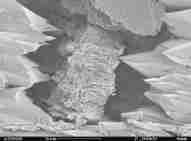
Most soils, even sandy soils, contain some 'fines' or small clay particles.  Clay  particles are not round, but are flat, jagged and arranged in 'plates'.  Sodium causes a cationic bond to occur between these plates, literally sticking them together and forming a waterproof layer that the wastewater cannot drain through.

Clay particles in a septic tank soakaway under an electron microscope.


Clay Particles under an electron microscope

A 10 year documented research has recently been completed by Dr. Robert Patterson and it concludes: "The inevitable consequence of continual addition of sodium in septic tank effluent is a decrease in the soil's hydraulic conductivity leading, in many cases, to drainfield failure."

The causes of soakaway failure in septic tank systems

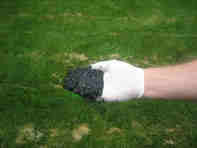
Septic system soil failure may be biological and/or chemical. These conditions often occur in sequence. When sodium causes chemical (cationic) exchanges, clay Septic Tank Soakaway Biomattparticles bond together to form a waterproof layer which in turn causes the soakaway to fill with water, blocking the soil air spaces and causing biological death of air-dependent aerobic cleaning organisms in the soil.  Anaerobic bacteria take over and increase the problem by forming a 'biomatt' of black slime which soon blocks all of the soakaway. 
Farmers have long recognized that over time, sodium in irrigation water causes the finer soil particles to bond together into impermeable layers. In agriculture, this chemical change causes structural changes in the soil, leading to land which drains poorly.

In the septic tank soakaway, problems begin when a thin impermeable layer of bonded fine silts and clay develops directly under the drains or on the soakaway trench floor or walls.

This layer grows and soon a "waterproof" barrier developes.

The problem is that if wastewater contains an unbalanced mix of total cations, with over 50% of the total cations (sodium, potassium, calcium and magnesium) being present as sodium, then it above problems will occur in most soils over time.

How to identify septic tank soakaway failures

If, when you have your septic tank emptied, wastewater is seen pouring back into the tank from the soakaway pipe, you have a problem.

Please contact us for more information.


Powered by Create

The NEW Crystal Septic Tank

The new CRYSTAL Septic Tank from Crystal Tanks.

VORTEX

The VORTEX wastewater treatment system range from  £1460 + VAT. Vortex Sewage treatment plant 6 person 

Distributers Wanted
Distributers and Installers wanted throughout UK and Worldwide for all types of treatment plant sales and installations.
Please ring for details of the Countries and Counties still available for distributerships.
Tel 01757 288022
Act on CO2
BIOROCK sewerage treatment unit website link
No Electricity
The system you have been waiting for!
Septic Tank Failure
Free surveys for soakaway failures.  Full reports  for Litigation
Caravan Parks
Valence  large wastewater systems are excellent value for money.
Wastewater Tutorial
Sewage treatment plant and septic tank system design and construction.