
Tank Legislation and Regulations
More Sewage LEGISLATION
- Confusion surrounding the EN 12566-3:2005 explained
- Emptying of Septic Tanks and Sewage Treatment Plants
- Building Regulations - relevant to sewage treatment plants and Septic Tanks
- The Environment Agency's Regulations
PACKAGE SEWAGE TREATMENT PLANTS (under 50 population) INSTALLED UNDERGROUND WHICH ARE NOT SUBJECT TO VEHICULAR TRAFFIC
The new Standard for packaged underground sewage treatment units under 50 persons sold in most of Europe is the EN12566-3 2005. The EN12566-3 is also required for CE marking, and CE marking is mandatory in the UK. Any plant, or conversion system, which does not have the EN12566-3 Certificate is not allowed to be sold.
The Construction Products Regulations 1991 require Package Sewage Treatment Plants (PSTP) offered for supply in the UK to be watertight, structurally stable, durable, to have sufficient treatment capacity and to offer effective treatment for the development in which it is to be installed.
Manufacturers wishing to market underground PSTPs in the UK must be able to provide incontrovertible evidence that their plant satisfies these criteria. This evidence is provided by having the BS EN 12566-3 Certificate.
The EN12566-3 Certificate is absolutely mandatory under the Construction Products 'CE Marking' Directive. It is also a requirement under Environment Agency General Binding Rules that all sewage treatment plants have this Certificate
The British Standards Institute have advised us that ONLY package plants which have the EN12566-3 2005 Certification are legal, without a Permit, in the UK.
The Environment Agency requires all new septic tanks to have the EN12566-1 Certificate under the General BInding Rules for septic tanks.
The EN 12566-3 only tests the percentage reduction of the influent pollutants in the sewage and gives no guarantees that the final effluent quality will satisfy the Environment Agency Consent Standard that you have to adhere to. Another anomaly is that the manufacturer can decide how many litres of sewage the plant treats each day and some plants are only tested for 4 people when they are sold as 6 person plants.
Before purchasing any sewage treatment unit we would strongly recommend that you see the manufacturers INDEPENDENT final effluent test report to make sure that the unit produces an effluent standard of no greater than 20:30:20(BOD:SS:NH3) on a 95 percentile basis as this is the Standard required in the UK and many sewage treatment plants which have the EN12566-3 do not meet this Standard.
DEMAND THE TEST REPORTS, NOT THE CERTIFICATE! - you may be surprised when they are refused!
The EN 12566-3 2005 does not cover the systems below, some of which have their own EN 12566 category:
Septic tanks - EN 12566-1 or 4
Sewage treatment plants over 50 persons size - EN 12255 parts 1 to 16
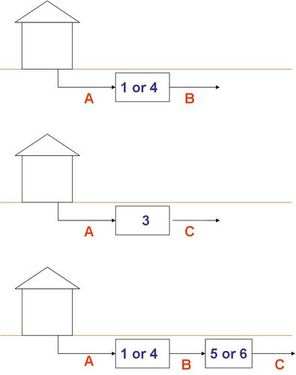 | A = Wastewater B = Pre-treated Wastewater (Septic Effluent) C = Treated Wastewater (Cleaned Effluent) 1 = Prefabricated Septic Tank 3 = Packaged and/or Site Assembled Wastewater Treatment Plant 4 = Septic Tank Built in situ 5 = (No longer applicable) 6 = Pre-Fabricated Treatment units for septic tank effluent 7 = Prefabricated Tertiary Treatment Units |
| IF IN DOUBT - FIND OUT! |
| The "Permit Exemption" and "Permit to Discharge" are no longer legal requirements attached to the property if the treatment plant that serves it has an EN12566 Certificate - provided that the installation and discharge arrangements comply with the Environment Agency General Binding Rules. If the system does not have an appropriate EN certificate, then you still need a Permit, even if the installation does comply with the General Binding Rules. Not to have one can pose problems in the event of a sale of the property. In all cases. your system MUST adhere to ALL the General Binding Rules, or you will need a Permit for whatever system you install. |
Building Regulations - relevant to sewage treatment plants and Septic Tanks
The Building Regulations 2000 - Drainage and Waste Disposal 2002 edition Part H-H2 Package Sewage treatment Works
The main provisions of these regulations are:
- The Sewage Treatment Plant must be sited more than 7m from habitable property
- The soakaway must be a minimum of 10 metres from a watercourse, 15 metres from a building and 50 metres from a borehole or spring.
- The soakaway must be designed to BS6297: 2007 and all percolation test results must be submitted.
- The discharge point shall be more than 10m from habitable property
- If the discharge is to a soak away a sampling chamber must be provided before the soak away. These are available from WTE Ltd..
- Drainage field drains must be constructed in the aerobic soil layer, i.e. within 700mm. of ground level.
Emptying Septic Tanks and Sewage Plants
It is highly illegal for anyone, other than a licensed waste disposal contractor to empty and dispose of all effluent from septic tanks and sewage plants. The effluent must be taken to fully recognised and licensed sewerage treatment works. The regulated water companies operate these works. It cannot be spread onto farmland, as it is a disease risk for animals and crop contamination. The fines are substantial if the Farmer is caught, and as livestock does not use toilet paper, the source of the manure is highly evident..
Documents issued by the DTLR and CIRIA all point out that septic tank soakaways are a major cause of sewage treatment system failure. Often, these failures result in septic effluent finding its way into watercourses.
It is also stated in Part H2 of the 2000 Building Regulations that "Septic tank effluent can be harmful" This refers to septic tank effluent in both watercourses and groundwater.
If your septic tank system malfunctions and discharges effluent (no matter how clean) to a watercourse you are committing an offence under Section 85 of the Water Resources Act 1991, rendering you liable on conviction in the magistrates' court to up to 3 months imprisonment or a fine not exceeding £100,000. On conviction at the Crown Court, you face to up to six months in jail and an unlimited fine.
Under the General Binding Rules, all existing septic tanks that discharge into ditches or streams MUST be replaced by sewage treatment plants - or have drainfields installed - by 1st January, 2020.
You could apply to the Environment Agency for a Permit to Discharge, but Consent would not be given for septic effluent, only for effluent from a sewage treatment unit.
You also cannot discharge into a watercourse or ditch anything poisonous or injurious to fish under the Salmon and Freshwater Fisheries Act 1975. Septic Tank effluent is extremely poisonous to aquatic life.
If, as defined by the Act, the watercourse is a "main river", the outfall structure may also require consent under S.109 Water Resources Act 1991.
Septic tanks with clinker beds do NOT classify as a sewage treatment plant suitable for discharging effluent to a watercourse as they can never achieve the modern required standards.
Think very hard before installing a septic tank as sewage treatment units are always the better choice
The choice of sewage system should be done very early in your projects development. Environment Agency Discharge Permits can take 4 months to obtain, if your choice of system does not conform to the General Binding Rules, set down by the E.A. in January 2015..
Some sites with clay soils and no access to a watercourse, prove very difficult, if not impossible to sustain any form of drainage or wastewater treatment at all, so it is vital that this area is addressed before purchase.
The Planning Authority consults with both the Environment Agency, or SEPA, Building Control and Environmental Health in order to determine whether your planning application can be passed or not. But BEWARE as some sites sold with planning permission have foul drainage as a RESERVED MATTER and it may not have been finalised.
Building Control is responsible for ensuring that your site drainage and sewage system complies with section H of the building regulations. Download it from Links.
The NHBC etc.warranty is only given for the sewage system if it is designed and installed to their standards and some Mortgage providers will insist on the property having such a warranty. In any case, they will insist that the treatment system is adequate and sustainable.
You only install a sewage treatment system once - DO IT RIGHT